
Search Results for 'Athletic Fitness'

Avaleht » Forums » Otsi » Search Results for 'Athletic Fitness'

Viewing 13 results - 976 through 988 (of 988 total)
  • Autor
    Search Results
  • #10629
    chip
    Member

    Fitness Show 2007

    1. VÕISTLUSTE KORRALDAJA

    Võistluste peakorraldaja Eesti Fitnessi Föderatsioon.

    2. AEG JA TOIMUMISKOHT

    Võistlused toimuvad 12. mail 2007 Kohtla-Järvel,

    Aadressil Ahtme klubis, Mardi 6.

    Võistlejate registreerimine kell 11.00 – 12.00.

    Võistluste algus kell 13.00.

    3. VÕISTLUSTE LÄBIVIIMINE

    3. 1. Mehed võistlevad 4 kategoorias: fitness, performance, athletic, super body.

    3. 2. Eraldi arvestust meessoost ja naissoost võistlejatele sõltuvalt vanusest ei toimu.

    3. 3. Naised kõik võistlevad 2 kategoorias: fitness, model fitness.

    3. 4. Võistlemine toimub kolmes osas: proportsioonide võrdlemine, vabakava ja

    kohustuslikud poosid.

    3. 5. Vabakava pikkus on kuni 1,5 minutit.

    3. 6. Toimub absoluutne paremusjärjestus nii meestele, kui naistele kulturismireeglite

    järgi.

    3. 7. Peakohtunikul on õigus eemaldada võistlustelt tasemele mittevastav sportlane.

    3. 8. Iga võistleja võib võistelda individuaalselt ainult ühes kategoorias.

    4. NÕUDED VÕISTLEJATELE

    4. 1. Kõik võistlejad peavad esitama passi või mõne muu isikut tõendava dokumendi..

    4. 2. Kõik võistlejad peavad omama CD – d, millele on kirjutatud võistleja nimi.

    4. 3. Iga võistleja vastutab personaalselt oma tervisliku seisundi eest.

    4. 4. Koos ühe klubi võistleja(te)ga on lubatud siseneda tasuta ainult ühel esinadajal

    või abistajal või treeneril.

    5. AUTASUSTAMINE

    Võitjaid autasustatakse karikatega ja sponsorite poolsete auhindadega.

    6. OSAVÕTUMAKS

    Kõigile osavõtjatele 250 krooni. Osavõtumaks tasutakse kohapeal või võistluste ennem ülekannega! Arvet võite tellida interneti kaudu.

    7. INFO JA REGISTREERIMINE

    President Pavel Kossenko, tel. 58 030 296, 64 59 156

    E – mail: info@maxsport.ee

    Võistluste korraldusdokument asub ka internetis: eff.maxsport.ee

    #10456
    AnneP
    Member

    Tänä viikonloppuna eli 21.-22.4 kilpaillaan Oslon GP:ssä. Lauantaina vuorossa ovat GP:t kehonrakennuksessa ja classic bodybuildingissa. Sunnuntaina nähdään areenalla body fitness ja athletic fitness kilpailut.

    Kisoihin ilmoittautuneet löytyvät Norjan kehonrakennusliiton sivuilta eli täältä.

    Onnea kisaan, Imre oslogp2007.jpg

    #10042
    Arnold
    Member

    OSLO GRAND PRIX 2007

    AMATEUR COMPETITION – Oslo, Norway, April 21st – April 22nd 2007

    – MEN’S AND WOMEN’S BODYBUILDING

    – MEN’S CLASSIC BODYBUILDING

    – WOMEN’S BODY FITNESS

    – MEN’S AND WOMEN’S ATHLETIC FITNESS (incl. dips & rowing)

    Welcome to “Oslo Grand Prix 2007” – Amateur competition in Bodybuilding, Body Fitness and Athletic Fitness. The competition is arranged by The Norwegian Bodybuilding and Fitness Federation (www.nkf-ifbb.no).

    LOCATION:

    The competition will be held at Sentrum Scene, Oslo on Saturday April 21st (Bodybuilding) and Sunday April 22nd (Body Fitness and Athletic Fitness).

    CATEGORIES:

    Men’s BODYBUILDING as follows:

    Light-Middleweight (<80 kg)

    Middleweight (<90 kg)

    Light-Heavyweight (<100 kg)

    Heavyweight (>100 kg).

    Women’s BODYBUILDING:

    Middelweight (<57 kg)

    Heavyweight (>57 kg)

    Men’s CLASSIC BODYBUILDING will have two height classes; up to 178cm and over 178 cm.

    Women’s BODY FITNESS will have two height classes; up to 163cm and over 163 cm.

    Women’s ATHLETIC FITNESS will have two height classes; up to 165cm and over 165 cm.

    Men’s ATHLETIC FITNESS will have two height classes; up to 180cm and over 180 cm.

    If a class has less than 4 athletes, the competitors will be transferred to the next class.

    SCHEDULE:

    Saturday April 21st : Prejudging for Bodybuilding starts at 13.00 hrs and the Finals starts at 19.00 hrs.

    Sunday April 22nd : The Fitness competition begins with Body Fitness classes at 12.00 hrs.

    WEIGH-IN/REGISTRATION

    The weigh-in for bodybuilders will be held at Partner Gym on Friday 20th April from 1800 hrs till 2000 hrs. The registration for fitness competitors will be held at Sentrum Scene on Sunday 22nd April at 1000 hrs.

    COMPETITION FEE

    There is a starting fee of NOK 200,- for the competition. The fee is to be paid at the weigh-in/registration.

    PRIZE MONEY

    There is prize money to be won in the overall classes:

    Mens Bodybuilding: 1st place – 2000 E

    2nd place – 1000 E

    3rd place – 500 E

    Womens Bodybuilding: 1st place – 1500 E

    Classic Bodybuilding: 1st place – 1000 E

    .

    Bodyfitness Women: 1st place – 1000 E

    .

    Athletic Fitness Men: 1st place – 0

    Athletic Fitness Women: 1st place – 0

    ENTRY FORM

    The entry form is attached or can be found on our website and must be filled in by the National federation. Deadline for the entry forms is 10 April.

    Send your entry form by email to NKF’s Webmaster

    Jorun Steine web@nkf-ifbb.no

    HOTEL

    Thon Hotel Terminus

    Stenersgaten 10

    0184 Oslo

    Tlf.: +47 22 05 60 00

    Faks.: +47 22 17 08 98

    terminus@thonhotels.no

    Location

    The hotel is located in the downtown area of Oslo within easy walking distance from the central railway station. Shops, restaurants, museums and theatres are all situated nearby, which gives you the opportunity to experience Oslo’s city life at its best! Our hotel staff will help you make the most out of your visit to Oslo, in order to make your trip memorable.

    http://www.thonhotels.no/terminus

    TICKETS

    Tickets are available on:

    http://www.billettservice.no Telephone +47 815 33 133

    Tickets are also available at the door. Prices: Saturday Prejudging NOK 100,- / Finals NOK 250,-. Sunday NOK 200,-.

    RULES

    The competition is arranged according to the rules set by IFBB/EFBB and NKF.

    MORE INFO:

    Visit our website at http://www.nkf-ifbb.no

    Or contact

    NKF’s President Bjørn Winberg

    Cellphone: +47 909 37 310

    E-post: prs@nkf-ifbb.no

    Or contact

    NKF`s Vice President Kim Torgersen

    Cellphone: +47 932 52 505

    E-post: Vprs@nkf-ifbb.no

    #10016
    Kaupmees
    Member

    Tõde

    Tõlkinud Pertov Sidorov

    SCHWARZENEGGER JA STEROIDID

    Vaadates Arnoldi omaaegseid fotosid, kus mees on oma vormi/karjääri tipus, tekib tahest tahtmata küsimus, kas Schwarzeneggeri lihased olid naturaalsed või oli kõik steroidide tulemus?

    Paljud tänased „Raualiigutajad“ ütlevad kogu selle loo peale, et: „Arnold on hea näide sellest, mida steroididega korda annab saata!“

    Ent ometi on Schwarzenegger „täna“ üks tulihingelisemaid steroidide vastaseid, propageerides noori mitte steroide tarvitama.

    Milline oleks siis reaalne tõde, kas väited, et Arnold oli seitsmekümnendatel „out of control steroid freak“ ???

    AUSUS JA OTSEKOHESUS OMA TEGEVUSE SUHTES

    Arnold pole kunagi olnud sõna otsese mõttes loll ega alaarenenud, ta teadis juba siis, mis on edasiminekuks ja läbilöömiseks vaja. Sel ajal kui teised (enamus) pro kulturistid üritasid oma steroidide kasutamist eitada, rääkis Arnold nendest avalikult. Väikestes broshüürides, mida ta läbi Muscle & Fitnessi postimüügina müüs, rääkis ta oma steroidide kasutamisest ausalt ja avameelselt.

    Broshüürile andis nime Arnold ise ja see oli: „Mr. Universumi füüsise arendamine“ ning see hakkas ilmuma 1977.a.

    Sel ajal rääkis Arnold oma steroidide kasutamisest järgmiselt: „Ma ei räägi oma kolleegide eest, kogu jutt tuleneb minu enda kogemustest. Jah tõepoolest ma olen neid kasutanud, kuid steroidid ei teinud mind selliseks nagu ma täna olen. Kasutasin neid lihase hoidmiseks ja massi säilitamiseks, kui olin rangel võistluseelsel dieedil. Ma ei ole kunagi kasutanud neid otseselt lihaste kasvatamise eesmärgil, pigem selleks, et dieedil kvaliteetset lihast mitte kaotada.“

    Siit alates Arnold ei üritanudki vassida ega meeletult oma steroidide kasutamist varjata. Isegi alles hiljutises intervjuus „TALK“ ajakirjale tunnistas ta, et: „Hingasin sisse ja välja kõike mida kätte sain!“

    Tõlkijalt: Hea väljend minu arust, inglise keeles “I inhaled, exhaled, everything”, arvan, et see võiks midagi sellist tähendada.

    Arnoldit hakati juba siis nägema üsna tihti sigarit suitsetamas, isegi Pumping Ironi võtete vahel.

    Ent Arnold on siiani jäänud väidete juurde, et ta ei kasutanud kunagi steroide spetsiaalselt massi saamiseks, ikka ainult, et dieedil olles massi hoida.

    Ja siinkohal on ka lugejale oluline meenutada, et enne Anabolic Steroid Control Act jõustumist 1990.a. ei olnud steroidide kasutamine „sportlikel eesmärkidel“ (athletic purposes) illegaalne.

    Ent tegelikkuses ei piirdu kogu lugu eelnevaga. Kulturistid, kes Arnoldi kõrgajal temaga koos treenisid, räägivad, et tegelikkuses oli Schwarzeneggeri steroidide kasutamine märksa liberaalsem, kui ta oma 1977.a. bukletis räägib.

    Ric Drasin endine WWF maadleja, kes Arnoldiga pidevalt Gold´s Gymis Californias treenis räägib Arnoldist ja steroidide kasutamisest sel ajal üldse järgmist:

    ARNOLD JA RICK DRASIN

    „Aja jooksul kerkisid areenile aina uued ja uued anaboolikud – märksa tõhusamad ja keerulisemad ühendid tulid Euroopast pidevalt. Loomulikult ka mina proovisin enamikku neist. Parim oli Saksamaalt tulev Primobolan. See oli süstitav steroid, süstida tuli kord nädalas ning seda kombineeriti dianaboliga (methandrosthenolon). Arvake ära, kes veel sellest kombinatsioonist vaimustus? Arnold Schwarzenegger!

    Ja õigupoolest tema käest sain isegi ampullid. See oli tõeliselt efektiivne kombinatsioon ja aitas Arnoldil võita nii mõnegi Mr. Olympia. Ja kui ma ausalt ütlen, siis seitsmekümnendatel tarvitas Gold´s Gymis seda kombinatsiooni iga mees. Üldiselt oli sel ajal igasugust stuffi üsna kerge ja odav saada. „

    Niisiis – primobolan ja dianabol. Kas neid steroide kasutatakse primaarselt dieediperioodil massi säilitamiseks?

    Primobolan, tarbides 200 mg nädalas ei kutsu esile eriti suurt vedeliku peetust, stimuleerib väga efektiivselt jõu ja massi juurdekasvu. See on populaarne steroid algajate seas. Juba 8 nädalaga on võimalik kasvatada 4 – 7 kg kvaliteetset lihasmassi ja pärast kuuri ei kao see kuhugi. Nagu öeldud, vedelikupeetus lihastes on selle steroidiga minimaalne.

    Dianaboli populaarsus tuleneb tema vahetust ja kohestest väga tugevatest anaboolsetest efektidest, mida tarbimisel kogetakse. Isegi juba 4 – 5 tbl. päevas on piisav kogus põhjustamaks üsna efektiivseid anaboolseid resultaate. Dianaboli probleemiks on tema muutumine suurte dooside korral östrogeeniks, mis toob kaasa nn. Güno fenomeni (meestel hakkavad rinnad kasvama, nibudesse tulevad tükid, need muutuvad hellaks), samuti tekib dinaboli tarvitamise ajal suur vedelikupeetus. Seitsmekümnendatel, Arnoldi aegadel oligi dianabol populaarseimaks vormiks methandrosthenolon.

    Methandrosthenolon on 17 – alfa – alküülil baseeruv steriod, mis teeb temast jõu ja massi lisamisel väga efektiivse steroidi. Samas on ta ka suurtes kogustes maksale üks toksilisemaid steroide.

    Tulles tagasi teema juurde, siis see steroid on suure tõenäosusega ka Arnoldi massivsuse, tema suurte lihaste üks peamiseid põhjuseid.

    Nagu olete kindlasti juba aru saanud, mõlemad steroidid põhjustasid vedelikupeetust. See on aga viimane asi, mida kulturist enne võistlusi tahab.

    Seega tundub üsna tõenäoline, et steroidide sessioonid, mida Arnold ise ja Draisin kirjeldavad, ei piirdunud ainult võistluseelse lihasmassi säilitamisega.

    Pigem ilmneb ja tuleb tõdeda, et Arnold kasutas steroide lihaskasvuks isegi aastaringselt.

    Tõlkijalt: Julgeksin siinkohal vastu rääkida artikli ühele lõigule: „Tulles tagasi teema juurde, siis see steroid (dianabol) on suure tõenäosusega ka Arnoldi massivsuse, tema suurte lihaste üks peamiseid põhjuseid.“ Arvan, et kõigest hoolimata on Schwarzeneggeri näol tegemist geneetiliselt vägagi eelistatud füüsisega. Selles, et ta „metakat“ pihuga pani, pole loomulikult kahtlustki, ent respektiväärt on see, et mees tunnistab seda, isegi kui mitte täielikult, siis osaliseltki.

    Teame ju tänapäevalgi, mis toimub telgitagustes, aga ikka üritame kõike eitada!

    #105138

    In reply to: Buliimia

    marit
    Member

    No minu arust tervislik toitumine kätkeb endas paari buliimia ja anoreksia diagnostilist kriteeriumit

    #8554
    AnneP
    Member

    nm-bb-bf-cbb-af_webb_v2.jpg

    Viikon päästä eli 21.-22.10 järjestetään pohjoismaiden mestaruuskilpailut Karlstadissa, Ruotsissa. Mukana ovat kehonrakennus, Bodyfitness, Classic bodybuilding sekä Athletic fitness sarjat.

    Tässä vielä epävirallinen osallistujalista, joista ilmeisesti puuttuu vielä joitakin nimiä:

    BB Rullatuoli:

    Antoni Khadraoui – S

    BB-57kg

    Annelie Nilsson – S

    Helene Westerlund – S

    Madelene Hermansson – S

    Åsa Lötbom – S

    Lotte Bendix – D

    Susanna Mantila – F

    Jaana Kohonen – F

    Margareth Dybevk – N

    BB+57kg

    Lena Hedblad – S

    Eva Birath – S

    Marthe Sundby – N

    BB -70kg

    Tommi Kaukinen F

    BB-75kg

    Micke Andersson – S

    Sami Maaniemi – F

    BB-80kg

    Mats Ljung – S

    Ali Farouk – S

    Mahdi Shahmarvand – D

    Juha Hakala – F

    Jari Laine – F

    Martin Engström – N

    Thomas Askeland – N

    BB -85kg

    Mattias Öhlén – S

    Jerry Ossi – F

    Markku Ylijoutsijärvi – F

    Daniel Stisen – N

    BB -90kg

    Pierre Chamoun – S

    Ott Kiivikas – E

    Jacob Hansen – D

    Tommi Heinonen – F

    Sami Koponen – F

    Marko Heikkinen – F

    Joel Pascua – N

    BB-100kg

    Farzad Kazemi – S

    Henrik Lingh – S

    Kimmo Pätäri – F

    Timo Honkala – F

    Samuel Helgessen – N

    BB +100kg

    Kim Kold – D

    Christer Norman – S

    Csaba Kocsis – S

    Janne Käyhty – F

    Sami Jääskeläinen – F

    Veli-Pekka Niskanen – F

    Classic BodyBuilding -178cm

    Younes Laroussi – S

    Alexander Henden – S

    Kenny Håkansson – S

    Stiven Schmidt – D

    André Thesen – N

    Classic BodyBuilding +178cm

    Mauricio Toro – S

    Mats Egelstig – S

    Utti Hietala – F

    Voitto Suosaari – F

    Ronny Olsen – N

    Athletic Fitness -165cm

    Helena Forssén – S

    Tini Gardebrand – S

    Anoma Marasinghe – S

    Rita Hedvik – N

    Athletic Fitness +165cm

    Amelie Wejle – S

    Anna Bergli – S

    Anna Ambjörnsson – S

    Behira Goli – S

    Athletic Fitness -180cm

    Lucio Pelaez – S

    Zackarias Wihrén – S

    Rookie Westin – S

    Johan Gustafsson – S

    Anders Tengvert – S

    Pierre Kärfstedt – S

    Jörn Pettersen – N

    Ken Johansen -N

    Glen Waksvik – N

    Athletic Fitness +180cm

    Mattias Hagelin – S

    Fredrik Wettergren – S

    Seth Ronland – S

    Ako Rahim – S

    Peo Bergqvist – S

    Per Fisker Rasmussen – D

    Sondre Bjerke Mathisen – N

    Body Fitness -163cm

    Carina Isaksson – S

    Linda Fodor Egelstig – S

    Åsa Hällstorp – S

    Maria Andersson – S

    Katrin Skovgaard Petersen – D

    Tarja Vähäkuopus – F

    Susanna Lampela – F

    Pia Jansson – N

    Caroline Lam – N

    Ann Kristin Bundlie – N

    Body Fitness +163cm

    Catharina Wettermark – S

    Cici Benjaminsson – S

    Lina Eklund – S

    Marie Gibbon – S

    Dorthe Hoffmann – D

    Katarina Tunturi – F

    Riikka Alasalmi – F

    Nina Sandvoll Moe – N

    Ann Merethe Gudhus – N

    Mona Solli – N

    Fitness

    Sofie Nordenberg – S

    Marjo Krishi – F

    Nora Yrjölä – F

    Onkos Virosta lähdössä muita kuin Ott?

    #83972
    Arnold
    Member

    Herrar Classic Bodybuilding -178 cm R 1 R 2 R 3 Total-

    Pl: Namn: Förening: Po Pl Po Pl Po Pl poäng

    1 Imre Vähi Estland 5 1 8 2 5 1 13

    2 Germain Louisa Team Hardcore Alison Maria, Holland 10 2 7 1 10 2 17

    3 Martin Alexandersson Team reFORM, Västerås 15 3 16 3 15 3 31

    4 Patrik Andersson Team Gymbolaget, Linköping 23 4 19 4 21 4 40

    5 Tommy Liekola Team dXb Nutrition, Alingsås 23 5 25 5 24 5 49

    6 Heidar Heidarsson Island 30 6 x x x x 30*

    7 Tellis Katsogiannis Forshaga AK 35 7 x x x x 35*

    Herrar Classic Bodybuilding +178 cm R 1 R 2 R 3 Total-

    Pl: Namn: Förening: Po Pl Po Pl Po Pl poäng

    1 Kristj?n Sam?elsson Island 5 1 5 1 5 1 10

    2 Jack Ronnovius Träningsakademin, Helsingborg 10 2 10 2 10 2 20

    3 Seth Ronland Team Gymgrossisten, Trollhättan 20 4 15 3 18 4 33

    4 Mats Egelstig Omni Team, Stockholm 15 3 21 4 17 3 38

    5 Stefan Alexandersson Carpe Diem, Strängnäs 26 5 23 5 25 5 48

    6 Christer Ny Motiva Sportsclub, Karlshamn 34 6 34*

    7 Sigmund Olav Lie Team Fitnessplanet 35 8 35*

    8 Torbjörn Swedin Team Gymgrossisten, Trollhättan 35 7 35*

    Damer Bodyfitness Nybörjare R 1 R 2 R 3 Total-

    Pl: Namn: Förening: Po Pl Po Pl Po Pl poäng

    1 Anna Lübeck MM Sports, Göteborg 11 2 5 1 8 2 24

    2 Malin Östensson Team Umeå Atlet 6 1 12 2 7 1 25

    3 Nicole Froidevaux Team HälsaFitness, Solna 18 4 17 3 17 3 52

    4 Annika Stark Team Hälsan, Halmstad 16 3 19 4 20 4 55

    5 Lina Johansson MM Sports, Göteborg 29 5 23 5 23 5 75

    6 Madelene Westbom WARG Body Fitness TEAM, Göteborg 32 7 34 6 66*

    7 Josefin Persson Team Umeå Atlet 31 6 36 8 67*

    8 Camilla Davour Team Gymbolaget, Linköping 37 8 34 7 71*

    9 Amany Afifi Flex Gym, Tyresö 45 9 45 9 90*

    Damer Bodyfitness Grand Prix R 1 R 2 R 3 Total-

    Pl: Namn: Förening: Po Pl Po Pl Po Pl poäng

    1 Åsa Hällstorp Team Recoverysport.se, Ystad 6 1 8 2 6 1 20

    2 Ljuba Pantovic-Subotic Extreme Gym, Belgrad, Serbien-Mo 9 2 7 1 9 2 25

    3 Heidr?n Sigurdardóttir Island 15 3 15 3 15 3 45

    4 Maria Andersson Coach Online, Karlstad 20 4 20 4 20 4 60

    5 Kristin Kristj?nsdóttir Island 25 5 25 5 25 5 75

    Herrar Nybörjare -80 kg R 1 R 2 R 3

    Pl: Namn: Förening: Po Pl Po Pl Po Pl

    3 Fetyan Daoud Omni Team, Stockholm 15 3 15 3 15 3 30

    1 Thomas Malmborg Team http://www.Byggmuskler.nu, Höllviken 5 1 5 1 5 1 10

    2 Mikael Eckard Team Fairing, Järfälla 10 2 10 2 10 2 20

    Damer Nybörjare R 1 R 2 R 3

    Pl: Namn: Förening: Po Pl Po Pl Po Pl

    1 Kerstin Nilsson Athletic & Fitness Club, Torsby 5 1 5 1 5 1 10

    Herrar Overall Grand Prix R 1 R 2 R 3 Total-

    Pl: Namn: Förening: Po Pl Po Pl Po Pl poäng

    1 Darius Karpinski Polen 5 1 5 1 5 1 10

    2 Igor Milanovic Extreme Gym, Belgrad 10 2 12 2 13 3 25

    3 Jerry Ossi Finland 15 3 20 4 12 2 32

    4 Ahmad Ahmad Form & Fitness, Malmö 20 4 15 3 20 4 35

    5 Marko Dimitrijevic Extreme Gym, Belgrad, Serbien-Mo 26 5 24 5 25 5 49

    6 Sasha Stankovic Extreme Gym, Belgrad, Serbien-Mo 33 6 x x x x 33*

    7 Jari Mentula Finland 35 7 x x x x 35*

    8 Magnus Bess J?li?sson Island 36 8 x x x x 36*

    9 Sakawan Ahmed Team Gymgrossisten, Trollhättan 45 9 x x x x 45*

    10 Lasse Andersson Team Nutrition Outlet, Västerås 50 10 x x x x 50*

    Darius Karpinski 2006 Euroopa Absoluutne võitis ka NOGP 2006

    post-17-1148237853_thumb.jpg

    #7604

    Topic: Oslo GP

    AnneP
    Member

    Tänään kilpailtiin Oslossa kehonrakennuksen, Classic Bodybuildingin, Athletic Fitneksen ja naisten Bodyfitneksen amatööri GP kilpailu. Tässä tulokset:

    Athletic Fitness Miehet -180 cm:

    1. Allan Heitmann – Kaliber Gym FKK Norway

    2. Kristian Sewén – Flex Gym Tyresö Sweden

    3. Pierre Kärfstedt Kristinehamns – A&BK Sweden

    4. Eirik Solen – Team Fitnessplanet Norway

    5. Jørn Pettersen – Atletix Norway

    Athletic Fitness Miehet +180 cm:

    1.& Over All Glenn Agnar Eivindsen – Team Fitnessplanet Norway

    2. Bjørn Reiten – Ålesund KFK Norway

    3. Torkill Sager – Team Fitnessplanet Norway

    4. Glenn Erik Iversen – Partner Gym KFK Norway

    5. Ib Andre Brandshaug – Stavanger KFK Norway

    Bodyfitness Naiset (-164 cm):

    1. & Over all Monica S. Høyer – Kaliber Gym FKK Norway

    2. Vibeke Henningsen – Haralds Gym Norway

    3. Jeanette Hansen – Geir`s FKK

    4. Andrea Eidesmo – Lasses Gym Norway

    5. Maria Andersson – Coachonline Norway

    Bodyfitness Naiset (+164 cm):

    1. Janne Moland Johansen – Team Fitnessplanet Norway

    2. Hei?r?n Sigur?ardóttir – Iceland

    3. Nina Jeanett Furseth – Partner Gym KFK Norway

    4. Johanne Aasbakk – Haralds Gym Norway

    5. Hege Mathisen – Team Fitnessplanet Norway

    Bodybuilding Naiset (-57 ja +57 samassa)

    1. sekä Over all : Marthe Sundby

    2. Jorun Steine

    3. Catrin Rudling

    Classic Bodybuilding -178cm

    1. Bjørgulf Hansen

    2. Yilmaz Dusunceli

    3. Rein Egil Olaussen

    4. Patrik Olsson

    5. Daniel Thomsen

    Classic Bodybuilding +178cm

    1. Jack Ronnovius, voitti myös Over All:in

    2. Allert Nilsen

    3. Håvard Dønnestad

    4. Sigmund Olav Lie

    5. Tom Adam Antonsen

    Bodybuilding -80kg

    1. Ståle Sæterbø

    2. Marius Graaterud

    3. Daniel Myrvold

    4. Ali Tabra

    5. Kenneth Klasson

    Bodybuilding -90 kg

    1. Jerry Ossi ,myös OVER ALL VOITTAJA

    2. Joel P Pascua

    3. Roar Innlagen

    4. Lasse Andersson

    5. Peter Rudling

    BB-100kg:

    1. Kim Torgersen

    2. Rune Gregersen

    3. Kenneth Svensen

    4. Kenneth Mandal

    5. Magn?s Bess J?l?usson

    BB+100kg:

    1. Jari “Bull” Mentula + 3. Over All

    2. Øyvind Fjeldseth

    3. Lasse Edvardsen

    4.Jan Vegar Gjerdrum

    Paras poseeraaja: Daniel Myrvold

    Huomenna illalla on kisoista galleriat Pakkotoisto.comissa. Mika Sirén ja Toni Bergholm olivat kuvaamassa kilpailua. He ovat vielä Oslossa, mutta laittoivat pari kuvaa nähtäville jo nyt. Nämä kuvat löytyy osoitteesta:

    http://www.pakkotoisto.com/vbulletin/showt&#8230;?t=47708&page=2

    #80397

    In reply to: Ekspandri harjutusi ?

    stainless
    Member
    #7212
    Anonüümne
    Guest

    ma uurisin kunagi fitnessi kohta ja hr. arnold postitas mulle ühe pika inglise keelse teksti fitnessi kohta.sellel tekstil pidi olema ka eestikeelne tõlge kuskil!?

    hädasti oleks vaja!

    aitäh!

    tekst ise on siin:

    A BIT OF HISTORY

    Women have always been interested in beautiful and shaped physique but muscles and women is a relatively new combination. Women begun to exercise in gyms in the 1970-s, mainly as a girlfriends or wives of experienced men bodybuilders. They quickly noticed that their bodies responded to weight training in the similar way as the bodies of their men’s partners. So, the ladies wanted to compete and to compare their achievements.

    The first Women’s World Championships took place in Los Angeles in 1979 and 1980 the first Ms. Olympia was staged in Philadelphia, Pennsylvania. Taking the above into consideration, we can say that women’s competitive bodybuilding has had nearly 25 years of experience. The idea was quickly spread among the IFBB National Federations and at the beginning of 1980-s more and more countries have begun to organize their Women’s National Championships. Nowadays, 30-40 National Teams participate in the World Women’s Bodybuilding and Fitness Championships.

    The main goal of FEMALE BODYBUILDING has always been the same – to develop the body in terms of:

    •SHAPE

    •SYMMETRY

    •MUSCULARITY

    •MASS

    •DEFINITION

    However, the practical results were different in different periods of time. In the first phase of female bodybuilding development, let’s say the first 15 years, ladies used to train in the same manner as men and they were judged at the contests in the same manner as men.

    As a result female bodybuilders have become heavier and more muscular year by year. Their bodyweight reached the level 60-70 kg at the contests and 80-90 kg off season. Progress in muscularity and definition was so big that the top women bodybuilders in the late 90-ties were so advanced that competitors from the early years didn’t look like true bodybuilders compared to them. It was too much even for the professional women bodybuilders.

    In this point we have to realize, that there were no doping control at those times, so the top women bodybuilders could develop muscle mass easier and faster. They could also achieve very sharp definition, similar to that showed by men bodybuilders. IFBB implemented the doping tests at the 1986 World Men’s Bodybuilding Championships and then began to test also the top amateur women bodybuilders. Doping tests have never been applied to professional bodybuilders

    (except tests for diuretics), so the development of amateur and professional female bodybuilding has gone its own, different ways. The problem of excessive muscle mass has never been so drastic in female amateur bodybuilding like in professional bodybuilding.

    A wide discussion was started out in the IFBB in the middle of 90-s, how to change the trends and how to modify judging rules to stop the muscle mass race among women bodybuilders. Bodybuilding reached the barrier of acceptance by the society and the barrier of acceptance by female competitors. On the other hand, more and more female bodybuilders expressed their feelings that they don’t want to “overdevelop” their bodies. They preferred softer approach to physique competition. They wanted to use weight training to get firm, shapely bodies. As a result of this discussion, a new sport has been created – fitness.

    FITNESS is a composition of:

    • ATHLETIC DEVELOPMENT and

    • ATHLETIC ABILITY

    Fitness competitor not only need to have shapely, proportioned body, she need to perform a routine displaying her strength and flexibility. IFBB officially accepted fitness at the 1995 International Congress and the first amateur contests were held in 1996. Fitness has begun its successful carrier, which finally lead to further splitting. There are two types of fitness now:

     GYMNASTIC FITNESS, which includes 1- minute routine and

     BODY FITNESS, without a routine.

    The number of competitors at the world and continental championships is still the same BODY FITNESS is a new sport discipline, implemented by the IFBB in 2002 to give a chance to compete for wide group of shapely women working out in gyms but with no gymnastic experience and gymnastic ability. It’s interesting that during the first phase of fitness development a common opinion was that female bodybuilding would die. It hasn’t happened. Women amateur bodybuilding still has its enthusiasts and its fans.

    WHAT THE JUDGES ARE LOOKING FOR?

    DEFINITIONS

    BODY PROPORTIONS

    General proportions: horizontal – broad shoulders, narrow waist; vertical – adequately long legs to shorter trunk. Also adequate arms, neck, head, feet.

    BALANCE

    All muscle groups should be developed to a similar degree. All bodyparts should be in harmony. No so called “weak points” or underdeveloped muscles.

    SYMMETRY

    Symmetry means that the same muscles, like right and left biceps, are similar in mass and shape.

    MUSCLE MASS

    How big, thick and full the muscles are? It is also called “the size” of the muscles. Muscle mass should be evaluated depending on the skeletal structure.

    MUSCLE SHAPE

    The curves of the muscle, from the beginning to the end. It depends greatly on the genetics, but may be corrected by a proper training.

    MUSCLE DENSITY

    Similar term: muscle maturity. The hardness of the muscle. It depends on the training experience and how much fat is stored inside the muscles.

    SEPARATION

    It means deep separation lines between the muscle groups, like deep vertical grooves between all thigh muscles.

    DEFINITION

    Also called striation or cut-up means that a lot of details are visible on the muscle surface. It is necessary to have thin skin, no fat, no water under it. And muscles should be hard. In the case of female competitor there is one more factor:

    FEMININITY

    We should have in mind that our target is to find out the best, ideal female physique. Muscular but still feminine shape physique..

    DEFERENCIES IN PHYSIQUE ASSESSMENT OF FEMALE COMPETITORS

    FEMALE BODYBUILDING

    There are three bodyweight classes:

     up to 52 kg

     up to 57 kg

     over 57 kg

    The competitors are judged in elimination round (if more than 15) and two other rounds: semifinal and final. The competitors shall wear two-piece bikini in all rounds and should be barefoot. The bikini bottom must cover two-third of the buttocks. No glasses, watches and jewelry. Skin creams and body oil may be used. The competitors perform:

    SEMIFINAL:

    – four compulsory poses in groups of five, in numerical order

    – five compulsory poses in comparisons

    FINAL:

    – free posing routine (60 seconds)

    – five compulsory poses as one group

    – posedown (60 seconds)

    Overall shape and harmonious, classical physique should be taken into consideration.

    Good posture, correct anatomical structure, broad shoulders, high chest, straight legs, good overall proportions are key points. Good skin tone, no scars or tattoos. Muscular development must not be so big like in the case of male physique. Definition of a woman’s muscles must not be so sharp like men’s.

    Competitors shall move in a graceful manner while being on stage. In the posing routine competitors should display their physique to the music. It should be smooth, well-choreographed routine. Compulsory poses and other poses may be included. Coordination and overall performance should be taken into consideration.

    GYMNASTIC FITNESS

    There are three height classes in women’s gymnastic fitness:

     160 cm

     167 cm

     over 167 cm

    The competitors are judged in elimination round (if more than 15) and three other rounds:

    SEMIFINAL:

    Round 1: Two-piece bikini and high-heels. One-half of the buttocks must be covered.

    G-strings are strictly prohibited in all rounds. The hair may be styled and jewelry may be worn.

    First the competitors perform four turns in groups of five, in numerical order. Then the judges may ask for comparisons.

    Round 2: Routine (1 minute). Attire of her choice, props are permitted to some extend (can’t leave any substance or oil on the surface of the stage) body oil is prohibited. Competitors may be barefoot or in athletic shoes.

    FINAL:

    Round 3: Two-piece bikini and high-heels, like in Round 1. They perform four turns as one group. Additionally, competitors perform their routines, but this part is not judged.

    The competitors perform four quarter-turns in rounds 1 and 3, also in comparisons. Judges should remember that they are judging female fitness, not female bodybuilding, so the muscularity, vascularity and definition of bodybuilding style are not acceptable in fitness. The athletes should be judged as “total package”.

    Judges should take into consideration general impression of the physique, the overall athletic appearance and bearing, the overall image, the poise and self-confidence of the competitors. Additionally, the hair and facial beauty also is to be considered. The physique should be symmetrically developed, with balanced muscularity and good overall proportions. The muscle groups should have round and firm appearance with small amount of body fat. Physique should not be too muscular or too lean.

    In round 2 only the fitness routine are judged, not the physique. This should be creative, unique routine performed at high speed. The overall impression is once again an important factor in judges evaluation. The routine should include strength elements (like straddles, leg extensions, push-ups) and flexibility movements (like splits, high kicks). The additional factor is showmanship, based on stage presence, charm and charisma of the competitors. The routine should be well-choreographed, performed with elegance and to the music.

    BODY FITNESS

    There are three height classes in women’s body fitness:

     158 cm

     164 cm

     over 164 cm

    There are three rounds in body fitness but there are no routine, so all rounds are physique-assessment rounds. The competitors perform four quarter-turns in all rounds. This time the attires are different in each round and become an important factor.

    SEMIFINAL:

    Round 1: Two-piece bikini

    The bikini should be plain, black in color, matt in texture. No ornamentation. It should cover minimum of ½ of the gluteus maximus. High-heels will be worn during this round. Black, classic stiletto pump, with a closed toe and heel should be worn. Platform high-heels will be strictly prohibited. The hair may be styled, jewelry is not permitted (except of wedding ring and/or small earrings). First the competitors perform four turns in groups of five, in numerical order. Then the judges may ask for comparisons.

    Round 2: One-piece swimsuit

    This time color, material, texture at the discretion of the competitor. The swimsuit must cover a minimum of one-half of the buttocks and all of the frontal area. High-heels must be classic stiletto pump, with a closed toe and heel, color at the competitor’s discretion. Platform high-heels will be strictly prohibited. The hair may be styled and jewelry may be worn. First the competitors perform four turns in groups of five, in numerical order. Then the judges may ask for comparisons.

    FINAL:

    Round 3: Two-piece bikini

    Color, material, texture at the discretion of the competitor. The bikini must cover a minimum of one-half of the buttocks and all of the frontal area. High-heels is worn in this round but the style and color is for choice of the competitor. Competitors perform only four turns as one group.

    Platform high-heels will be strictly prohibited. The hair may be styled, jewelry may be worn. In all rounds the judge should first assess the overall athletic appearance of the physique.

    The assessment, beginning with a general impression of the physique, should take into consideration the hair and facial beauty; the overall athletic development of the musculature; the presentation of a balanced, symmetrically developed physique; the condition of the skin and the skin tone and the athlete’s ability to present herself with confidence, poise and grace.

    The muscle groups should have a round and firm appearance with a small amount of body fat. The physique should be free from deep muscle separation and/or striations. The skin tone should be smooth and healthy in appearance, and without cellulite. The face, hair and makeup should complement the “Total Package” presented by the athlete. It seems that all rounds are equal and may be judged in the same manner nut the judges must take into consideration that a competitor may present a different general impression while wearing a swimsuit with high-heels as opposed to a bikini with high-heels. Therefore, judges must ensure that this round is judged from a “fresh” perspective. The same is with the round 3. The competitors may present a different general impression while wearing a two-piece bikini of their own choosing.

    .

    TRAINING BASICS

    BODYBUILDING GYMNASTIC FITNESS BODYFITNESS

    Weight training Weight training Weight training

    Aerobics Aerobics Aerobics

    Dieting Dieting Dieting

    Routine Flexibility (gymnastics)

    Stretching

    Routine

    So, the basement of all three physique sports are: weight training, aerobics and dieting. Then, each sport has its own specific components.

    Bodybuilder needs to practice 5 compulsory poses and free posing routine to the music of her choice. Several weeks are needed to prepare all these posing and routine.

    In fitness, several months is needed to prepare the routine.

    This include:

    • The choice of music and composition of special sound effects

    • Design and making of the special, attractive attire

    • Selection of the strength and flexibility movements, design of the choreography

    of the entire routine

    • Training of the separate elements as well as entire routine

    There is no problem with the routine in body fitness, so this type of fitness is widely available for women. Weight training is necessary in all three sports, however with different intensity and range.

    The main target of female bodybuilders is to develop muscle mass to the champion level. They usually train 5-6 days in a week, no more than 1-2 bodyparts on a single workout. They do 3-4 exercises per bodypart and 3-4 sets per exercise. Repetitions are within the range of 8 to 12. They do a lot of exercises with free weights and use a special Weider Training Principles to increase the intensity: Progressive Overload, Pyramiding, Forced Reps, etc.

    Usually they use training cycles during the year .The main cycles are:

    • strength cycle

    • mass building cycle

    • definition cycle

    Additionally, they train aerobics but no more than 3 times a week for 30-40 minutes during a year and in the precontest cycle (the last 12-14 weeks).

    They increase the number of aerobic workouts to 5-6 per week and make them longer – about 60 minutes.

    There are different targets in fitness and body fitness training.

    There is no necessary to develop muscle mass over accepted limits, except the situation some bodypart is weaker and the competitor wants to develop it to achieve better symmetry and harmony of her physique. But generally the main target of fitness girl is to keep the lean, firm muscles with smaller bodyweight differences within a year. Most of fitness competitor use only two cycles:

    • body quality cycle

    • precontest cycle

    In reference to fitness, there are additional targets: the girl needs to have enough strength and energy to perform the 1-minute very dynamic routine. This problem doesn’t exists in body fitness.

    This involves not only the training techniques but also dieting with a bit higher consumption of carbohydrates to cover the higher demands for energy.

    The fitness competitors usually train four days in a week, using the simple split training system: two days on – one day off – two days on. Sometimes they use the system: three days on – one day off – one day on. They do 4-5 exercises and 3-4 sets per exercise. The rage of repetition is a bit higher:12-15 per sets with the loads of about 70% of that used by bodybuilders. They train faster, more dynamic than bodybuilders and used shorter brakes between sets. Regarding the aerobics they train 5-6 times per week for 60 minutes during the year and increase it to 2 times per day for 7 days per week, if necessary.

    #77260

    In reply to: FITNESS

    Arnold
    Member

    Teks on olemas ka Eesti keeles , kuid väga vigases tõleks.

    Lugege hoolega, siit peaks välja kooruma, mis vahe on kulturismil ja fitnessil.

    EUROPEAN BODYBUILDING & FITNESS FEDERATION

    INTERNATIONAL COACHES, TRAINERS & JUDGES COURSE

    BUDAPEST, HUNGARY, MAY 2004

    FEMALE BODYBUILDING, FITNESS

    & BODY FITNESS

    by Andrew Michalak, M.Sc.

    EBFF Judges Committee

    Member

    A BIT OF HISTORY

    Women have always been interested in beautiful and shaped physique but muscles and women is a relatively new combination. Women begun to exercise in gyms in the 1970-s, mainly as a girlfriends or wives of experienced men bodybuilders. They quickly noticed that their bodies responded to weight training in the similar way as the bodies of their men’s partners. So, the ladies wanted to compete and to compare their achievements.

    The first Women’s World Championships took place in Los Angeles in 1979 and 1980 the first Ms. Olympia was staged in Philadelphia, Pennsylvania. Taking the above into consideration, we can say that women’s competitive bodybuilding has had nearly 25 years of experience. The idea was quickly spread among the IFBB National Federations and at the beginning of 1980-s more and more countries have begun to organize their Women’s National Championships. Nowadays, 30-40 National Teams participate in the World Women’s Bodybuilding and Fitness Championships.

    The main goal of FEMALE BODYBUILDING has always been the same – to develop the body in terms of:

    •SHAPE

    •SYMMETRY

    •MUSCULARITY

    •MASS

    •DEFINITION

    However, the practical results were different in different periods of time. In the first phase of female bodybuilding development, let’s say the first 15 years, ladies used to train in the same manner as men and they were judged at the contests in the same manner as men.

    As a result female bodybuilders have become heavier and more muscular year by year. Their bodyweight reached the level 60-70 kg at the contests and 80-90 kg off season. Progress in muscularity and definition was so big that the top women bodybuilders in the late 90-ties were so advanced that competitors from the early years didn’t look like true bodybuilders compared to them. It was too much even for the professional women bodybuilders.

    In this point we have to realize, that there were no doping control at those times, so the top women bodybuilders could develop muscle mass easier and faster. They could also achieve very sharp definition, similar to that showed by men bodybuilders. IFBB implemented the doping tests at the 1986 World Men’s Bodybuilding Championships and then began to test also the top amateur women bodybuilders. Doping tests have never been applied to professional bodybuilders

    (except tests for diuretics), so the development of amateur and professional female bodybuilding has gone its own, different ways. The problem of excessive muscle mass has never been so drastic in female amateur bodybuilding like in professional bodybuilding.

    A wide discussion was started out in the IFBB in the middle of 90-s, how to change the trends and how to modify judging rules to stop the muscle mass race among women bodybuilders. Bodybuilding reached the barrier of acceptance by the society and the barrier of acceptance by female competitors. On the other hand, more and more female bodybuilders expressed their feelings that they don’t want to “overdevelop” their bodies. They preferred softer approach to physique competition. They wanted to use weight training to get firm, shapely bodies. As a result of this discussion, a new sport has been created – fitness.

    FITNESS is a composition of:

    • ATHLETIC DEVELOPMENT and

    • ATHLETIC ABILITY

    Fitness competitor not only need to have shapely, proportioned body, she need to perform a routine displaying her strength and flexibility. IFBB officially accepted fitness at the 1995 International Congress and the first amateur contests were held in 1996. Fitness has begun its successful carrier, which finally lead to further splitting. There are two types of fitness now:

     GYMNASTIC FITNESS, which includes 1- minute routine and

     BODY FITNESS, without a routine.

    The number of competitors at the world and continental championships is still the same BODY FITNESS is a new sport discipline, implemented by the IFBB in 2002 to give a chance to compete for wide group of shapely women working out in gyms but with no gymnastic experience and gymnastic ability. It’s interesting that during the first phase of fitness development a common opinion was that female bodybuilding would die. It hasn’t happened. Women amateur bodybuilding still has its enthusiasts and its fans.

    WHAT THE JUDGES ARE LOOKING FOR?

    DEFINITIONS

    BODY PROPORTIONS

    General proportions: horizontal – broad shoulders, narrow waist; vertical – adequately long legs to shorter trunk. Also adequate arms, neck, head, feet.

    BALANCE

    All muscle groups should be developed to a similar degree. All bodyparts should be in harmony. No so called “weak points” or underdeveloped muscles.

    SYMMETRY

    Symmetry means that the same muscles, like right and left biceps, are similar in mass and shape.

    MUSCLE MASS

    How big, thick and full the muscles are? It is also called “the size” of the muscles. Muscle mass should be evaluated depending on the skeletal structure.

    MUSCLE SHAPE

    The curves of the muscle, from the beginning to the end. It depends greatly on the genetics, but may be corrected by a proper training.

    MUSCLE DENSITY

    Similar term: muscle maturity. The hardness of the muscle. It depends on the training experience and how much fat is stored inside the muscles.

    SEPARATION

    It means deep separation lines between the muscle groups, like deep vertical grooves between all thigh muscles.

    DEFINITION

    Also called striation or cut-up means that a lot of details are visible on the muscle surface. It is necessary to have thin skin, no fat, no water under it. And muscles should be hard. In the case of female competitor there is one more factor:

    FEMININITY

    We should have in mind that our target is to find out the best, ideal female physique. Muscular but still feminine shape physique..

    DEFERENCIES IN PHYSIQUE ASSESSMENT OF FEMALE COMPETITORS

    FEMALE BODYBUILDING

    There are three bodyweight classes:

     up to 52 kg

     up to 57 kg

     over 57 kg

    The competitors are judged in elimination round (if more than 15) and two other rounds: semifinal and final. The competitors shall wear two-piece bikini in all rounds and should be barefoot. The bikini bottom must cover two-third of the buttocks. No glasses, watches and jewelry. Skin creams and body oil may be used. The competitors perform:

    SEMIFINAL:

    – four compulsory poses in groups of five, in numerical order

    – five compulsory poses in comparisons

    FINAL:

    – free posing routine (60 seconds)

    – five compulsory poses as one group

    – posedown (60 seconds)

    Overall shape and harmonious, classical physique should be taken into consideration.

    Good posture, correct anatomical structure, broad shoulders, high chest, straight legs, good overall proportions are key points. Good skin tone, no scars or tattoos. Muscular development must not be so big like in the case of male physique. Definition of a woman’s muscles must not be so sharp like men’s.

    Competitors shall move in a graceful manner while being on stage. In the posing routine competitors should display their physique to the music. It should be smooth, well-choreographed routine. Compulsory poses and other poses may be included. Coordination and overall performance should be taken into consideration.

    GYMNASTIC FITNESS

    There are three height classes in women’s gymnastic fitness:

     160 cm

     167 cm

     over 167 cm

    The competitors are judged in elimination round (if more than 15) and three other rounds:

    SEMIFINAL:

    Round 1: Two-piece bikini and high-heels. One-half of the buttocks must be covered.

    G-strings are strictly prohibited in all rounds. The hair may be styled and jewelry may be worn.

    First the competitors perform four turns in groups of five, in numerical order. Then the judges may ask for comparisons.

    Round 2: Routine (1 minute). Attire of her choice, props are permitted to some extend (can’t leave any substance or oil on the surface of the stage) body oil is prohibited. Competitors may be barefoot or in athletic shoes.

    FINAL:

    Round 3: Two-piece bikini and high-heels, like in Round 1. They perform four turns as one group. Additionally, competitors perform their routines, but this part is not judged.

    The competitors perform four quarter-turns in rounds 1 and 3, also in comparisons. Judges should remember that they are judging female fitness, not female bodybuilding, so the muscularity, vascularity and definition of bodybuilding style are not acceptable in fitness. The athletes should be judged as “total package”.

    Judges should take into consideration general impression of the physique, the overall athletic appearance and bearing, the overall image, the poise and self-confidence of the competitors. Additionally, the hair and facial beauty also is to be considered. The physique should be symmetrically developed, with balanced muscularity and good overall proportions. The muscle groups should have round and firm appearance with small amount of body fat. Physique should not be too muscular or too lean.

    In round 2 only the fitness routine are judged, not the physique. This should be creative, unique routine performed at high speed. The overall impression is once again an important factor in judges evaluation. The routine should include strength elements (like straddles, leg extensions, push-ups) and flexibility movements (like splits, high kicks). The additional factor is showmanship, based on stage presence, charm and charisma of the competitors. The routine should be well-choreographed, performed with elegance and to the music.

    BODY FITNESS

    There are three height classes in women’s body fitness:

     158 cm

     164 cm

     over 164 cm

    There are three rounds in body fitness but there are no routine, so all rounds are physique-assessment rounds. The competitors perform four quarter-turns in all rounds. This time the attires are different in each round and become an important factor.

    SEMIFINAL:

    Round 1: Two-piece bikini

    The bikini should be plain, black in color, matt in texture. No ornamentation. It should cover minimum of ½ of the gluteus maximus. High-heels will be worn during this round. Black, classic stiletto pump, with a closed toe and heel should be worn. Platform high-heels will be strictly prohibited. The hair may be styled, jewelry is not permitted (except of wedding ring and/or small earrings). First the competitors perform four turns in groups of five, in numerical order. Then the judges may ask for comparisons.

    Round 2: One-piece swimsuit

    This time color, material, texture at the discretion of the competitor. The swimsuit must cover a minimum of one-half of the buttocks and all of the frontal area. High-heels must be classic stiletto pump, with a closed toe and heel, color at the competitor’s discretion. Platform high-heels will be strictly prohibited. The hair may be styled and jewelry may be worn. First the competitors perform four turns in groups of five, in numerical order. Then the judges may ask for comparisons.

    FINAL:

    Round 3: Two-piece bikini

    Color, material, texture at the discretion of the competitor. The bikini must cover a minimum of one-half of the buttocks and all of the frontal area. High-heels is worn in this round but the style and color is for choice of the competitor. Competitors perform only four turns as one group.

    Platform high-heels will be strictly prohibited. The hair may be styled, jewelry may be worn. In all rounds the judge should first assess the overall athletic appearance of the physique.

    The assessment, beginning with a general impression of the physique, should take into consideration the hair and facial beauty; the overall athletic development of the musculature; the presentation of a balanced, symmetrically developed physique; the condition of the skin and the skin tone and the athlete’s ability to present herself with confidence, poise and grace.

    The muscle groups should have a round and firm appearance with a small amount of body fat. The physique should be free from deep muscle separation and/or striations. The skin tone should be smooth and healthy in appearance, and without cellulite. The face, hair and makeup should complement the “Total Package” presented by the athlete. It seems that all rounds are equal and may be judged in the same manner nut the judges must take into consideration that a competitor may present a different general impression while wearing a swimsuit with high-heels as opposed to a bikini with high-heels. Therefore, judges must ensure that this round is judged from a “fresh” perspective. The same is with the round 3. The competitors may present a different general impression while wearing a two-piece bikini of their own choosing.

    .

    TRAINING BASICS

    BODYBUILDING GYMNASTIC FITNESS BODYFITNESS

    Weight training Weight training Weight training

    Aerobics Aerobics Aerobics

    Dieting Dieting Dieting

    Routine Flexibility (gymnastics)

    Stretching

    Routine

    So, the basement of all three physique sports are: weight training, aerobics and dieting. Then, each sport has its own specific components.

    Bodybuilder needs to practice 5 compulsory poses and free posing routine to the music of her choice. Several weeks are needed to prepare all these posing and routine.

    In fitness, several months is needed to prepare the routine.

    This include:

    • The choice of music and composition of special sound effects

    • Design and making of the special, attractive attire

    • Selection of the strength and flexibility movements, design of the choreography

    of the entire routine

    • Training of the separate elements as well as entire routine

    There is no problem with the routine in body fitness, so this type of fitness is widely available for women. Weight training is necessary in all three sports, however with different intensity and range.

    The main target of female bodybuilders is to develop muscle mass to the champion level. They usually train 5-6 days in a week, no more than 1-2 bodyparts on a single workout. They do 3-4 exercises per bodypart and 3-4 sets per exercise. Repetitions are within the range of 8 to 12. They do a lot of exercises with free weights and use a special Weider Training Principles to increase the intensity: Progressive Overload, Pyramiding, Forced Reps, etc.

    Usually they use training cycles during the year .The main cycles are:

    • strength cycle

    • mass building cycle

    • definition cycle

    Additionally, they train aerobics but no more than 3 times a week for 30-40 minutes during a year and in the precontest cycle (the last 12-14 weeks).

    They increase the number of aerobic workouts to 5-6 per week and make them longer – about 60 minutes.

    There are different targets in fitness and body fitness training.

    There is no necessary to develop muscle mass over accepted limits, except the situation some bodypart is weaker and the competitor wants to develop it to achieve better symmetry and harmony of her physique. But generally the main target of fitness girl is to keep the lean, firm muscles with smaller bodyweight differences within a year. Most of fitness competitor use only two cycles:

    • body quality cycle

    • precontest cycle

    In reference to fitness, there are additional targets: the girl needs to have enough strength and energy to perform the 1-minute very dynamic routine. This problem doesn’t exists in body fitness.

    This involves not only the training techniques but also dieting with a bit higher consumption of carbohydrates to cover the higher demands for energy.

    The fitness competitors usually train four days in a week, using the simple split training system: two days on – one day off – two days on. Sometimes they use the system: three days on – one day off – one day on. They do 4-5 exercises and 3-4 sets per exercise. The rage of repetition is a bit higher:12-15 per sets with the loads of about 70% of that used by bodybuilders. They train faster, more dynamic than bodybuilders and used shorter brakes between sets. Regarding the aerobics they train 5-6 times per week for 60 minutes during the year and increase it to 2 times per day for 7 days per week, if necessary.

    #76363

    In reply to: õlaprobleem

    Arnold
    Member

    Soovitan põhjalikult tudeerida teksti :

    KINESIOLOGY AND BIOMECHANICS OF SHOULDER JOINT MOVEMENTS ON RESISTANCE TRAINING EXERCISES

    By Professor Maur?cio de Arruda Campos, Ph.Ed.

    Anatomy of the Shoulder Joint

    The shoulder girdle is made up of the clavicle and the scapula. The articulations within the shoulder girdle are the sternoclavicular, acromioclavicular and the coracoclavicular joints. The shoulder girdle articulates with the trunk at the sternum in a joint called sternoclavicular, with the thorax at the scapulothoracic joint and with the upper extremity with the humerus at the glenoumeral joint.

    The anatomical landmarks of the scapula that are of great importance for a good analysis and comprehension of shoulder movements are: the anterior and superior surfaces, the supraspinous, infraspinous, subscapular and glenoid fossa, the coracoid and acromion processes and the coracoacromial arch. The head, neck, greater and lesser tuberosities of the humerus are also very important anatomical landmarks for this bone.

    The sternoclavicular joint is very unstable because there is no bony prominence that helps to hold the two bones together. This joint is the site for most of the movements of the scapula (elevation, depression, upward rotation, downward rotation, abduction and adduction) and is also were the axis of rotation is located for the movements of the shoulder girdle. It absorbs sideward impacts of the shoulder and has four ligaments that provide the stability for the articulation of the two bones.

    The acromioclavicular joint functions to absorb the stress of impacts on the shoulder and also have weak bony arrangements, thus poor stability.

    The coracoclavicular joint has a ligament arrangement that reinforce the weak acromioclavicular articulation by transferring the force applied to the acromion process of the scapula to the clavicle.

    Although there is no real bone-to-bone articulation between the acromion process and the coracoid process, there is the very important coracoacromial ligament that binds these two bony prominences. This ligament is of great importance as a buffer for the rotator cuff muscles (supraespinatus, infraespinatus, subscapular and teres minor) that run superior, posterior and anterior to the humeral head and can be subjected to pressure and impact from the acromion process during the performance of over arm movements.

    The shoulder joint is designed to provide great mobility and because of this its stability is reduced. The muscular arrangement of the shoulder girdle and the shoulder joint is designed to provide the stability that lacks as a result of weak bony and ligamentous arrangements. The muscles are strong enough to provide necessary stability, but the lack of upper body strength accounts for a great deal of injuries at the shoulder region.

    The shoulder joint is made up of the articulation of the scapula (glenoid fossa) and the head of the humerus. Less than half of the head of the humerus is in the socket at any one time and because of this the bony arrangement of the shoulder joint is weak. To help stabilize the joint there is a labrum or lip of cartilage that encircles the outer fossa to increase its depth to assist in keeping the head of humerus in place. The shoulder is a multi-axial joint (produces movements in three planes and axis). The glenoid fossa is directed slightly anteriorly providing a little more stability to backward movements of the humerus, but on the other side leaves the forward position more vulnerable to dislocations. As any other joint in the human body the stability of the shoulder depends on the bony, ligamentous and muscular arrangement and a joint that is designed for mobility like the shoulder joint have weak bony and ligamentous arrangements depending much more on its muscular strength and arrangement for stability. This is why it’s so important to have a good knowledge of shoulder mechanics and good technique to prevent injuries at this joint during resistance exercises.

    Muscles of the Shoulder Joint

    The intrinsic musculature that surrounds the shoulder joint is arranged to produce a very good stability. Part of these intrinsic muscles (four) is called the rotator cuff and has large stabilizing components that are directed medially. Thus, regardless of the humerus position, the rotator cuff is responsible for the maintenance of the head of the humerus close to the glenoid fossa. The contraction of the deltoid muscle, for example, produces an upward translation of the head of the humerus that must be counteracted by the components of depression from the rotator cuff muscles. Further stability is provided via the long head of biceps brachii (anteriorly) and triceps (posteriorly). As these muscles are antagonists the biceps have a greater stabilizing component when the shoulder joint is extended and vice-versa. As with the deltoid muscle, the upward component of these muscles (biceps and triceps) must be counteracted by the depression components of the rotator cuff muscles. Most of the other muscles also have some stabilizing component at the shoulder but their main function is to move the joint so they are not considered stabilizer but movers and they are part of the extrinsic musculature.

    The muscles and the movements they produce at the shoulder complex are demonstrated at the table bellow:

    SHOULDER JOINT MUSCLES AND THEIR ACTIONS

    MOVEMENTS MUSCLES JOINTS THEY CROSS

    Flexion

    Biceps Brachii

    Anterior Deltoid

    Coracobrachialis

    Pectoralis Major (clavicular) Shoulder/Elbow/Radioulnar

    Shoulder

    Shoulder

    Shoulder

    Extension Posterior Deltoid

    Tr?ceps

    Latissimus Dorsi

    Teres Major Shoulder

    Shoulder / Elbow

    Shoulder

    Shoulder

    Abduction Middle Deltoid

    Supraespinatus Shoulder

    Shoulder

    Adduction Pectoralis Major

    Latissimus Dorsi

    Teres Major Shoulder / Sternoclavicular

    Shoulder

    Shoulder

    Medial Rotation Latissimus Dorsi

    Teres Major

    Subscapularis

    Anterior Deltoid

    Pectoralis Major Shoulder

    Shoulder

    Shoulder

    Shoulder

    Shoulder

    Lateral Rotation Infraespinatus

    Teres Minor

    Posterior Deltoid

    Shoulder

    Shoulder

    Shoulder

    Horizontal Adduction Pectoralis Major

    Coracobrachialis

    Anterior Deltoid Shoulder / Sternoclavicular

    Shoulder

    Shoulder

    Horizontal Abduction Triceps

    Posterior Delt Elbow/ Shoulder

    Shoulder

    Mechanics of Arm Abduction

    The nature of arm abduction is interesting and complex. The coordination of the shoulder complex not only allows the mobility necessary for the reaching, grasping and throwing functions of the upper extremity but also provides the structures necessary to stabilize an inherently weak bony and ligamentous arrangement. The motion of the scapula, clavicle and humerus to achieve full elevation of the arm is called Scapulohumeral Rhythm.

    The supraespinatus initiates the first few degrees of shoulder abduction because this muscle has a better angle of pull than the deltoid at the beginning of the movement. At initial stages, the stabilizing component is actually a dislocating one, because it is directed in such a way that it pulls the head of the humerus upward into the inferior side of the acromion process. To overcome this problem two thing occur: 1) As the humerus abducts, the scapula upwardly rotates at a ratio of 3:2, that is, the glenoid fossa rotates upward 2 degrees for every 3 degrees of humeral abduction. This action moves the acromion process out of the way as the greater tuberosity of the humerus approaches. 2) The rotator cuff muscles tense to stabilize the humeral head against the glenoid fossa so that the component of the deltoid muscle (that would tend to displace the humerus upward) is neutralized. Three of the rotator cuff muscles (infraespinatus, subscapularis and teres minor) have downward components to perform this stabilization.

    Shoulder impingement Syndrome

    Shoulder impingement syndrome is a common cause of shoulder and upper extremity pain and dysfunction in both athletic and nonathletic populations. It can occur in any age group and at various activity levels. Typically impingement occurs in athletes or workers who engage in repetitive overhead activities. Repetitive discrete or continuous skills that require the shoulder joint to be abducted of forward flexed and medially rotated cause shoulder pain in a significant number of athletes. Some people call this syndrome, the rotator cuff impingement syndrome, although only one rotator cuff muscle is impinged. The long head of the biceps brachii muscle (which is not part of rotator cuff muscle) also becomes impinged. The inflammation occurs from the squeezing of the supraespinatus tendon, which passes over the head of the humerus and under the coracoacromial ligament. The latter two structures make us what is known as the coracoacromial arch.

    The compression of the head of the humerus upward and inward to the glenoid fossa and the coracoacromial arch is a motion that should be prevented by those muscles that have force components downward and that stabilize the humerus against the upwardly directed forces. The stabilizing muscles are those that have a downward force components when the arm is abducted of flexed mainly over the shoulder height.

    Most functional glenohumeral motions occur in the same plane as the scapula which is approximately 30 to 45 degrees anterior to the frontal plane of the body. In this position, muscles are aligned optimally and the inferior joint capsule is not twisted.

    All four articulations of the shoulder must act together in order for proper shoulder motion to occur. The contribution of each articulation is necessary for full range of motion of the humerus. In the first 30-40 degrees of elevation the scapula moves little if at all. As elevation continues, the scapula rotates upward 1 degree for every two degrees of humeral elevation. The maximum amount of scapular rotation is about 60 degrees and since total elevation typically equals 180 degrees, the glenohumeral joint contributes about 90 to 120 degrees of the total elevation.

    Normal Scapulohumeral rhythm insures optimal position of the humeral head in the glenoid fossa thereby ensuring full range of motion and normal muscle (mainly the deltoid) length-tension relationships. During elevation, the humerus also needs to medially rotate to prevent its greater tuberosity from impacting against the acromion.

    Proper muscle function is also necessary to achieve full elevation of the arm. As the elevation of the humerus occur, the serratus anterior and the upper and lower trapezius muscles combine to form a force couple that upwardly rotates the scapula. The rotator cuff muscles are also important in normal mechanics of elevation. The supraespinatus helps the deltoid in abduction and is generally considered the most responsible for the initiation of this movement. As well, the supraespinatus is described as a stabilizer, functioning to position the head of the humerus on the glenoid fossa and to compress it against the glenoid. All the other muscles of the rotator cuff contract together to form help depress the head of the humerus. Thus these muscles are responsible for the dynamic stability of the shoulder. This depression of the humeral head is extremely important to prevent the head of the humerus to impact against the coracoacromial arch or acromion.

    Any condition that causes a narrowing of the subacromial space or enlargement of subacromial structures (mainly the supraespinatus tendon, the tendon of the long head of biceps and subacromial bursa) can also lead to impingement of these structures. Structural and physiological abnormalities can promote impingement. Structural etiologies include a curved acromion, calcium deposits, osteophytes, a thickened bursa, thickened ligaments or anything that diminishes the subacromial space.

    Physiological etiologies include excessive superior dislocation of the humeral head due to weakness of the rotator cuff muscles or impairment of the Scapulohumeral rhythm secondary to poor neuromuscular coordination or weakness of the muscles that promotes scapular upward rotation.

    Joint laxity is another cause of secondary impingement due to glenohumeral joint instability. Movements with excessive range of motion that increase joint laxity may lead to instability of the glenohumeral joint. Some examples of movements are excessive horizontal abduction at the bench press exercise or at the pectoral machine with the shoulder joint abducted 90 degrees and laterally rotated.

    Glenohumeral joint capsule tightness may also contribute to shoulder impingement. The tightness of the posterior capsule can lead to increased anterior gliding and increased superior migration of the humeral head during elevation.

    Tightness of the inferior capsule diminishes the amount of inferior movement of the head of humerus and if the head is not able to depress, the subacromial space is diminished, increasing the likelihood of impingement.

    Another area of consideration is called “the critical zone”, an area of hipovascularity in the distal supraespinatus muscle tendon. When the arm is adducted the head of the humerus compresses the supraespinatus tendon leading to lack of blood flow to this region of the muscle. This reduced circulation may indeed hasten the microscopic degenerative changes in the supraespinatus tendon.

    Conclusion

    Maximizing shoulder function is dependent on identifying and modifying structural, biomechanical or Kinesiological parameters. Many structural problems may need surgical correction in order to promote adequate subacromial space. Most biomechanical and Kinesiological problems may be prevented with a selection of safe exercises and proper form or can be treated conservatively.

    Normal strength of the direct humeral head depressors (teres minor, infraespinatus and subscapularis muscles) and normal joint capsule laxity are the key to successful management of shoulder impingement.

    Strengthening of the rotator cuff muscles is paramount to improve dynamic inferior glide or humeral depression mainly during overhead exercises.

    Strengthening of the scapular muscles is critical to allow for proper upward rotation of the scapula and to create a stable platform for humeral movement and prevent excessive approximation between the head of humerus and the coracoacromial arch, thus enhancing both stability and mobility of the shoulder complex.

    Restoration from tightness to normal joint capsule laxity and/or prevention of joint capsule excessive laxity can not be overlooked on the prescription of exercises. Mobilization and stretch techniques to improve posterior capsule flexibility and to improve inferior humeral glide may prevent upward migration of the humeral head during overhead activities. Also, a special care with excessive range of motion on selected exercises and arm positions may prevent excessive joint laxity in one particular side of the joint leading to imbalance and to both static and dynamic instability of it.

    With all these safety considerations most athletes could plan a very effective and safe shoulder exercises program that will enhance the stability of this joint and strengthen the muscles that surround it with a very low risk of injuries or chronic degenerative syndromes of the shoulder joint.

    Professor Maur?cio de Arruda Campos

    Professor of Kinesiology, Biomechanics and Fitness from the Faculty of Physical Education of the University of Franca – UNIFRAN;

    Professor of the Specialization Course of Strength training and Conditioning from the Faculty of Physical Education of the University Claretianas –CEUCLAR;

    Scientific Director from the Brazilian Federation of Bodybuilding and Fitness and Coach for the Brazilian Male Bodybuilding Team;

    Member of the Scientific Committee from the European Federation of Bodybuilding and Fitness;

    General Secretary of the Brazilian Association for Studies and Control of Doping;

    Owner of a Gym called F?sico & Forma since 1989;

    Biomechanics advisor for “NakaGym” Weight Training Equipment Industry;

    Author of four books in the area of Kinesiology and Biomechanics of Resistance Exercises

    #4489
    vend vähk
    Moderator

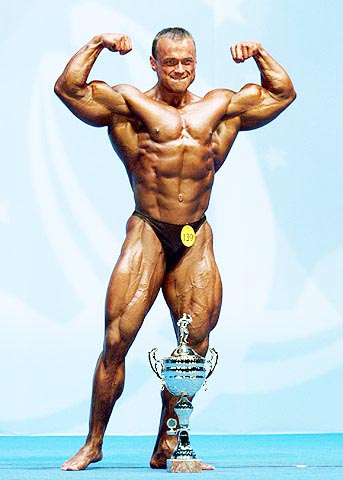
    Tere! Lisasin aadressile http://pilt.ee/vendv uue kataloogi sellest Riias nädalavahetusel toimunud üritusest. Homme jätkan piltide alla laadimist sellele aadressile. Vabandan piltide kehva kvaliteedi pärast, aga parem ikka kui mitte midagi. Juhin siinkohal tähelepanu Argo Aderi supervormile, mille eest teda ka finaalis athletic kategoorias absoluutselt teiseks tunnistati.

Viewing 13 results - 976 through 988 (of 988 total)